Before Prop 13, There Was Prop 14
In 1964, 65% of California voters put a right to refuse to sell or rent to anyone into the state constitution. It took the U.S. Supreme Court to undo it.
In 1963 the California Legislature passed the Rumford Fair Housing Act. It was written by Byron Rumford, the first Black legislator from Northern California, and it barred most landlords and home sellers from turning people away because of race, religion, or national origin. Governor Pat Brown signed it.
The California Real Estate Association (today the California Association of Realtors) fought the bill the whole way. Once it passed they collected over a million signatures, more than twice what they needed, to put an initiative on the November 1964 ballot. Proposition 14 added this to the state constitution:
Neither the State nor any subdivision or agency thereof shall deny, limit or abridge, directly or indirectly, the right of any person, who is willing or desires to sell, lease or rent any part or all of his real property, to decline to sell, lease or rent such property to such person or persons as he, in his absolute discretion, chooses.
It doesn’t mention race. It didn’t have to. The official ballot argument in favor complained that under the Rumford Act owners could no longer refuse buyers and renters “for reasons of race, color, religion, national origin, or ancestry.” The argument against said Prop 14 “would write hate and bigotry into the Constitution.”
It passed 4,526,460 to 2,395,747. That’s 65%.
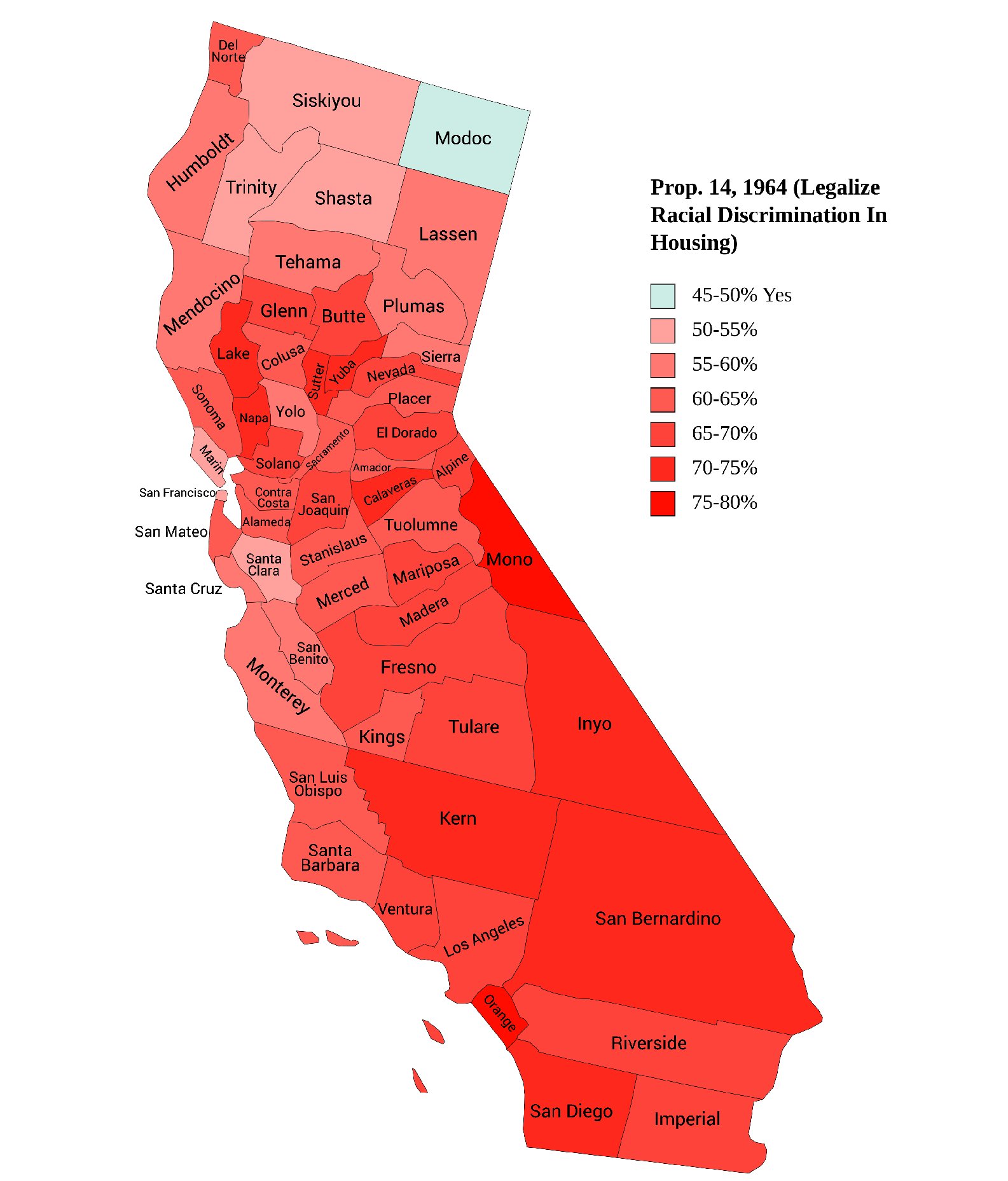
Map: Nyuuposting, CC BY-SA 4.0, via Wikimedia Commons.
Only a court could undo it
The legislature couldn’t fix this. Once something is in the constitution by initiative, lawmakers can’t repeal it on their own. It takes another statewide vote or a court.
It took a court. In May 1966 the California Supreme Court ruled 5–2 that Prop 14 violated the Equal Protection Clause of the Fourteenth Amendment (Mulkey v. Reitman). The U.S. Supreme Court affirmed in 1967, 5–4 (Reitman v. Mulkey). One vote the other way and Prop 14 stands. The dead text stayed in the constitution until voters removed it in 1974.
Madison called it
Federalist No. 10 is about this exact problem. If a faction is a minority, the majority can outvote it. If the faction is the majority, nothing stops it:
When a majority is included in a faction, the form of popular government, on the other hand, enables it to sacrifice to its ruling passion or interest both the public good and the rights of other citizens.
Madison’s fix was representation: elected legislators, a large republic, lots of competing interests. That process is what produced the Rumford Act. The initiative is what undid it.
Fourteen years later
Prop 13 passed in June 1978 with 64.8% of the vote, almost the same share as Prop 14. Same mechanism too: an initiative constitutional amendment, written outside the legislature, that mostly benefits people who already own property and that the legislature can’t change. Its biggest tax cuts go to long-held property in mostly white neighborhoods.
Almost two-thirds of voters approved Prop 14. Almost two-thirds approved Prop 13. Give a majority a way to lock in its own advantage and it will use it.
Corrections and data questions: info@prop13.wtf.