Special taxes aren’t increasing. General taxes are learning to look like them.
California has two kinds of local tax. A special tax is earmarked for a specific purpose and needs two-thirds of voters. A general tax can be spent on anything and needs a simple majority. The two-thirds rule comes from Prop 13 (1978); the definitions were settled by the courts in 1982 and written into the constitution by Prop 218 in 1996.
With Props 40–43 on the November 2026 ballot, which touch state special taxes (41) and local special taxes (43), we wanted to know: are special taxes becoming more common?
We pulled every city, county, and school district ballot measure from the California Elections Data Archive (1996–2025, 3,939 tax measures) and cross-checked against Michael Coleman’s local revenue measure tables, which also cover special districts.
No. Cities and counties have moved to general taxes.
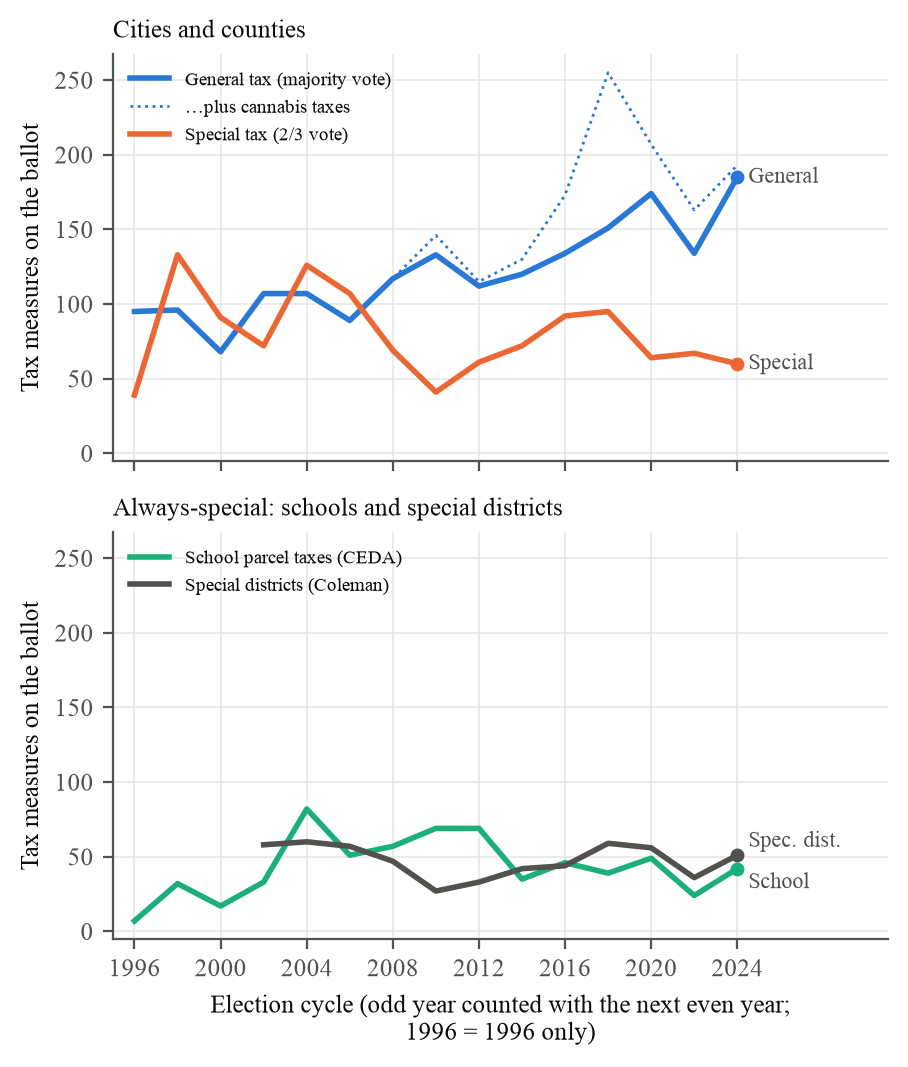
In most election cycles from 1998 to 2006, more than half of city and county tax measures were two-thirds-vote special taxes. Since 2018 it’s about a quarter. General tax measures roughly doubled (and that’s before counting the cannabis tax wave of 2016–2020, the dotted line). Special taxes went nowhere.
Schools and special districts can only levy special taxes, and their counts are flat too.
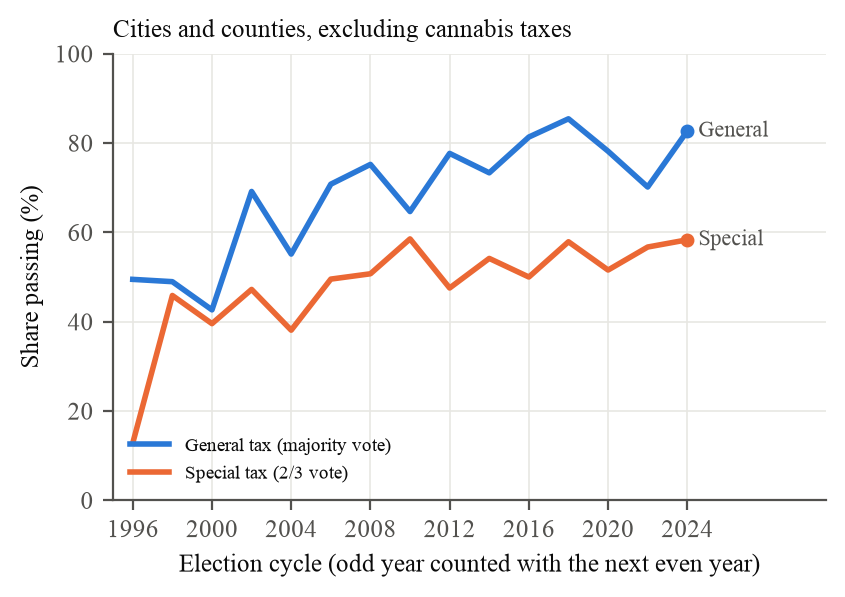
The reason isn’t a mystery. General taxes pass far more often:
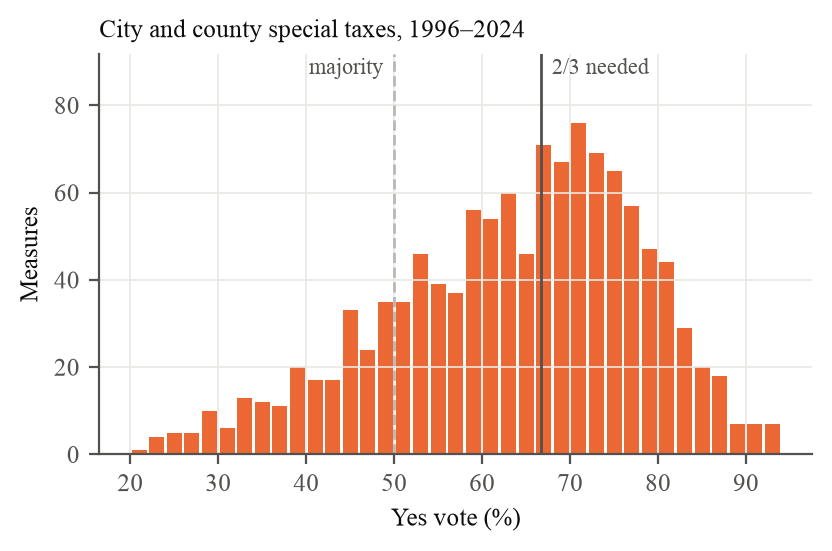
Over the whole period, about half of all failing special taxes won more than 55% of the vote. They were popular. They just weren’t popular with two thirds of voters.
But general taxes now read like special taxes
Here is how Long Beach described a utility users tax measure in 2000:
Shall the Ordinance which reduces the utility users tax by 25% (5% each year for 5 years), be adopted?
And in 2024:
Shall the measure to maintain general city services, including 911 response; firefighter/paramedic; pothole/street repairs; improve storm drains; afterschool programs; senior services; parks; libraries; public health; and homeless services, by […] applying Long Beach’s existing 5% gas utility user tax to said corporations/agencies […] be adopted?
Or Sacramento’s 2018 Measure U, a one-cent sales tax “to protect and enhance essential public safety services, including 9-1-1 response, fire protection, community neighborhood policing, […] homeless supportive services, affordable housing, libraries, park maintenance […]” which then adds that the money is “legally required to stay in the City’s General Fund.”
This is now the norm. We counted how many distinct public services (police, fire, streets, parks, libraries, homelessness, …) each ballot question names:
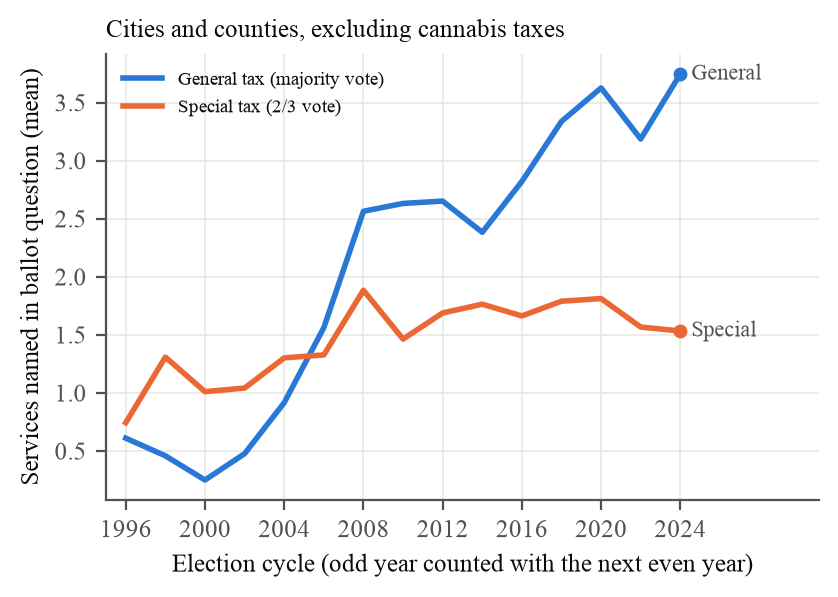
In 2000, 22% of city and county general tax measures named any service at all. In 2024, 91% did, and they named nearly four on average: more than the special taxes that are legally earmarked. About half now open with a purpose clause (“To maintain 9-1-1 response, fix potholes, …”) before getting to the question.
Does it work? Comparing general tax measures in the same city over time, each additional service named in the question goes with about 1.6 points more “yes” (±0.6) and a 5-point higher chance of passing. For actual special taxes the same comparison is about 1 point and not statistically distinguishable from zero. This is a correlation, not an experiment: cities pick their wording, often after polling it. But it’s consistent with the obvious story. Voters like earmarks. The law charges two thirds for a real earmark and a simple majority for the look of one.
What this means for November
Prop 43 would require two thirds for special taxes placed on the ballot by citizen initiative, which since Upland (2017) and the appellate rulings on San Francisco’s 2018 Props C and G have needed only a majority. That route is real and growing: Coleman’s tables list the first two in June 2018 and about 25 in November 2024 alone. But it’s small next to the roughly 185 non-cannabis general taxes cities and counties put on the ballot in the 2023–24 cycle, and Prop 43 leaves those alone.
Over thirty years the two-thirds rule doesn’t seem to have made voters approve fewer taxes. It has pushed local governments toward taxes whose legal use is unrestricted and whose ballot label is a list of promises. Whether that’s a good trade is a question for voters. But “special tax” versus “general tax” now says more about the vote threshold than about how the money will be spent.
Data and code: paper/special_taxes/ in this site’s repository. CEDA doesn’t cover independent special districts; those counts come from Coleman’s per-election PDFs and start in 2002. Service counts come from a keyword match on the ballot question text, so treat the levels as approximate. The trend is large and survives stricter matching: counting only unambiguous services (police/sheriff/911, fire/paramedic, potholes/street repair, parks, libraries, homelessness), general taxes go from 0.1 services named in 2000 to 2.2 in 2024 and overtake special taxes by the 2006 cycle.